
Greater Western Water (GWW) endorsed our Integrated Water Management Plan (IWMP) for 265 Lancefield Road, Sunbury on its first submission. There was no request for further information and no round of amendments, just a one-page letter of endorsement. For a development IWMP that is rare, and it cleared the way for the rest of the project’s approvals to move.
The brief
The site is a 12.3 hectare parcel in Hume City Council’s Lancefield Road Precinct Structure Plan, between Lancefield Road and the Bendigo rail line. It is planned for around 157 lots, a local park, and 3.2 hectares set aside for a potential TAFE or hospital. Condition 27 of the planning permit requires an IWMP endorsed by GWW before the project can move on to engineering plans and construction.
An earlier strategy for the site had been returned by GWW in June 2026. GWW’s feedback was that it did not show what the integrated water measures would actually achieve: it mentioned rainwater harvesting but did not say whether tanks were required, or how much drinking water they would save. Millar Merrigan, the project’s civil engineers, brought us in to prepare a new plan for the developer, Solovey, that would answer those questions properly.
Writing to the authority’s guidance
GWW publishes its Integrated Water Management Developer Guidance, which sets out what a development IWM plan must contain, including summary tables of site information, analysis assumptions and IWM commitments. We built the plan around that guidance and completed every table, so the reviewer could find each answer where they expected it.
The plan also sets the site in its wider context: the state and EPA stormwater objectives, Council’s requirements, Melbourne Water’s Oldbury Development Services Scheme, which treats the estate’s stormwater in a regional wetland beside Emu Creek, and the proposed Sunbury Regional Stormwater Harvesting Scheme downstream.
Measures sized to real demand
We looked at regional stormwater harvesting, rainwater tanks, passively irrigated street trees and infiltration on lots. Regional harvesting sits with the future Sunbury scheme, and the lots are too small for infiltration systems to sit a safe distance from houses and boundaries. The plan commits to the two measures that work at this scale.
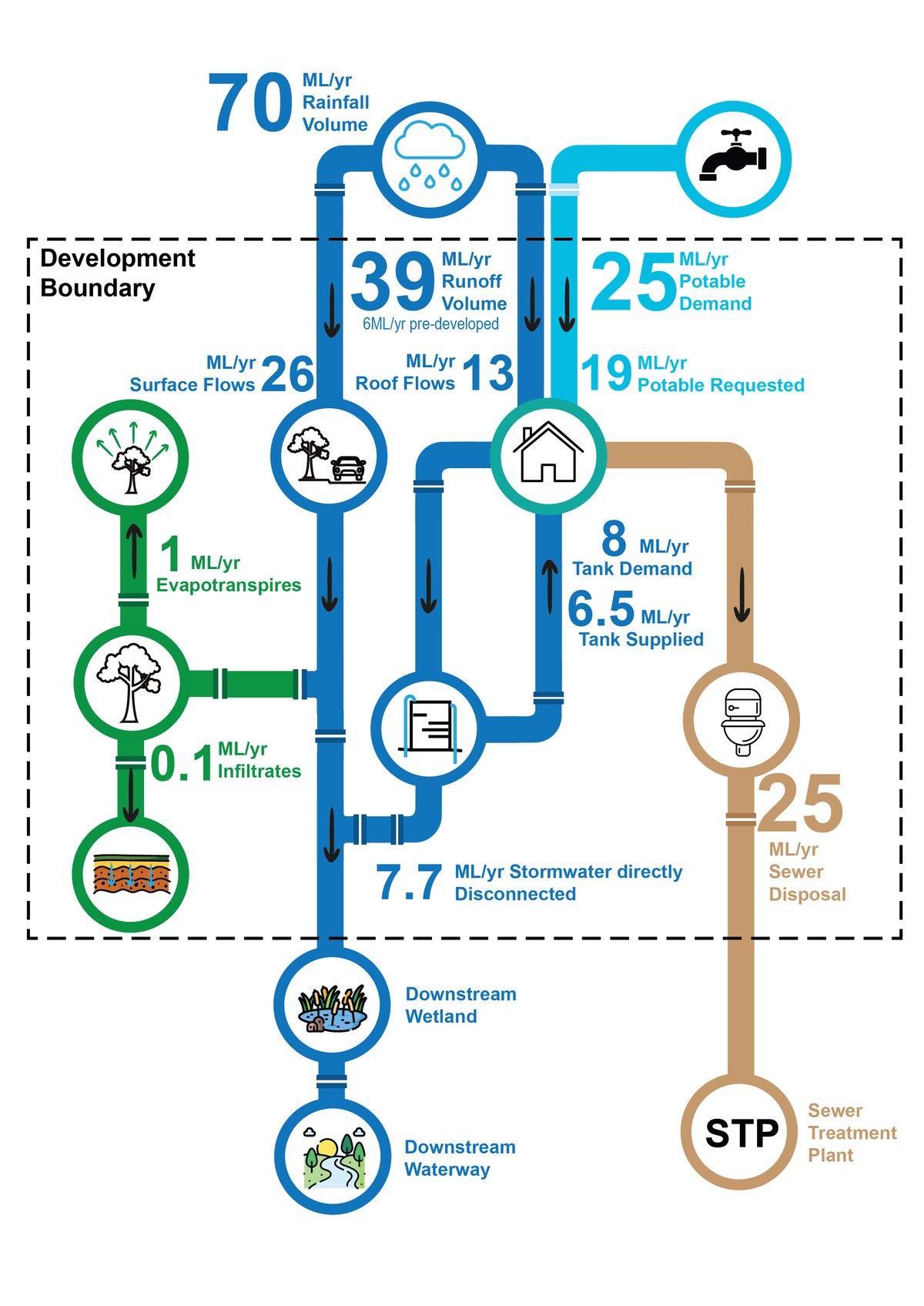
Every lot gets a 2 kL rainwater tank plumbed to the toilet and washing machine, the two indoor uses that draw water every day regardless of the season. We modelled the tanks in MUSIC with two people per household, fewer than the 2.6 the census records for Sunbury, so the savings are not overstated. Across the estate, toilets and washing machines need about 8 ML a year, and the tanks supply 6.5 ML of it. The modelling also showed the tanks refill quickly after use, so a bigger tank would not save more water. What limits reuse is demand, not storage.
Street trees are watered passively from the kerb, with a 3 m² gravel trench per dwelling that takes runoff from the road and feeds it to the tree roots. The trees return about 1 ML a year to the air through evapotranspiration, cooling the streets, and a further 0.1 ML soaks into the clay soils.
Hume City Council is reconsidering how passive street tree irrigation is applied in estates like this one, so this part of the plan may change as Council’s position settles. Watch this space.
The numbers
Around 70 ML of rain falls on the site in an average year. Before development about 6 ML of it runs off; once the estate is built that rises to around 39 ML. The homes will need about 25 ML of drinking-quality water a year. With the tanks in place, the estate asks GWW’s network for 19 ML instead, and together the tanks and trees keep 7.7 ML of stormwater a year out of the downstream waterways.
Taking that water out also takes pollutants with it. Within the site, the tanks and street trees remove about half the sediment load, 42% of the phosphorus and 27% of the nitrogen before the stormwater reaches the regional wetland, which then takes the estate the rest of the way to best practice.
GWW endorsed the plan in August 2026. See our feasibility and strategy services, how we work with land developers and water authorities, and more of our integrated water management projects.