
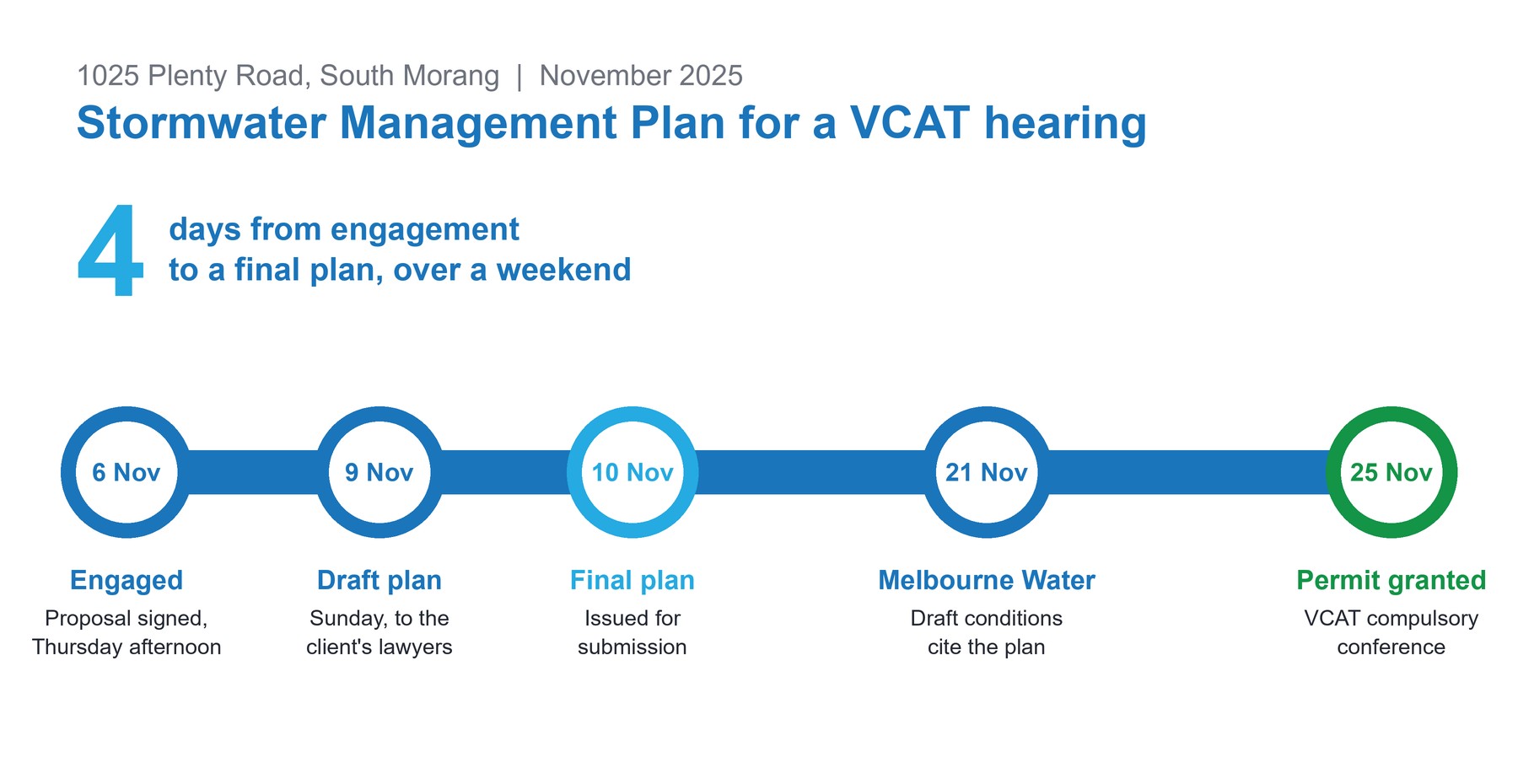
The application to develop 1025 Plenty Road, South Morang was headed to the Victorian Civil and Administrative Tribunal (VCAT), with a compulsory conference set for late November 2025. Council and Melbourne Water needed to see a workable stormwater strategy before then, and the developer’s legal team asked us to deliver one in days, not weeks. We were engaged on a Thursday afternoon, sent a draft to the lawyers on the Sunday and issued the final plan on the Monday. At the conference, VCAT set aside Council’s decision and granted the permit, with conditions that require the stormwater works to follow our plan.
The brief
The site is a 0.94 hectare paddock on the western side of Plenty Road in the City of Whittlesea, planned for 29 townhouses under an owners corporation. It falls from north-east to south-west, and its western boundary runs along the Melbourne Water pipe track, which is covered by a heritage overlay. The land sits in Melbourne Water’s Upper Henderson Creek Drainage Scheme, but the scheme drain that will eventually serve it has not been built yet.
Melbourne Water’s earlier advice set two clear tests. The outfall pipe had to stay out of the pipe track land, and the site had to hold back its flows so that the developed 1% AEP (1 in 100 year) discharge would be no more than the pre-development 20% AEP (1 in 5 year) flow. The plan needed to show both could be met on a small site, with a layout that was already drawn.
Fast, but not rushed
A tight deadline is no excuse for a plan that falls over under scrutiny, particularly one that will be read by lawyers, Council engineers and a referral authority. We used methods that suit a site of this size and that reviewers recognise: the Australian Rainfall and Runoff 2019 Rational Method with Bureau of Meteorology rainfall data for flows, a Boyd’s calculation to size the storage, and MUSIC set up to Melbourne Water’s 2024 guidelines for water quality. We also asked Melbourne Water for its drainage scheme models over the same weekend, so the next stage of design could start straight away.
The strategy
On-site detention
Once the site is built on, its 1% AEP peak flow rises to around 0.35 m³/s, against a pre-development 20% AEP flow of 0.065 m³/s. All minor and major flows are collected by the internal pipes and roads and taken to a shared detention basin that holds them back to that pre-development rate. The storage needed is about 230 m³, and the plan sets aside around 350 m² of the site to fit it.
An outfall that avoids the pipe track
Rather than cross the pipe track, a new pipe sized for the pre-development 20% AEP flow runs through the adjoining Council reserve to the existing drain in Badal Street. A 300 mm pipe would carry the flow at a 1 in 100 grade, but the plan allows for 375 mm because Council may expect that minimum for a pipe carrying road drainage.
Rainwater tanks doing double duty
The development’s sustainability plan already included a 2 kL rainwater tank for every dwelling. We modelled them in MUSIC, plumbed to the toilet and washing machine, with two people per household rather than the 2.8 the census records for South Morang, so the benefit is not overstated. The tanks meet about 75% of that demand and take out 27% of the nitrogen, 32% of the phosphorus and 35% of the sediment before stormwater leaves the site. That is 60% of the nitrogen target, which could reduce the development’s water quality contribution to the drainage scheme by a similar share. The scheme’s downstream assets take the site the rest of the way to best practice.
The outcome
Melbourne Water’s draft conditions, issued four days before the hearing, were written around our plan. On 25 November 2025, VCAT granted a permit for the subdivision and the 29 dwellings. Its conditions require the final stormwater strategy to be generally in accordance with the Water Studio plan dated 10 November 2025, including the detention basin and the outfall through the Council reserve.
If you have a planning matter with a stormwater question and a deadline, get in touch. See our feasibility and strategy services, how we work with land developers, and more of our stormwater management plans.